
Technical Details
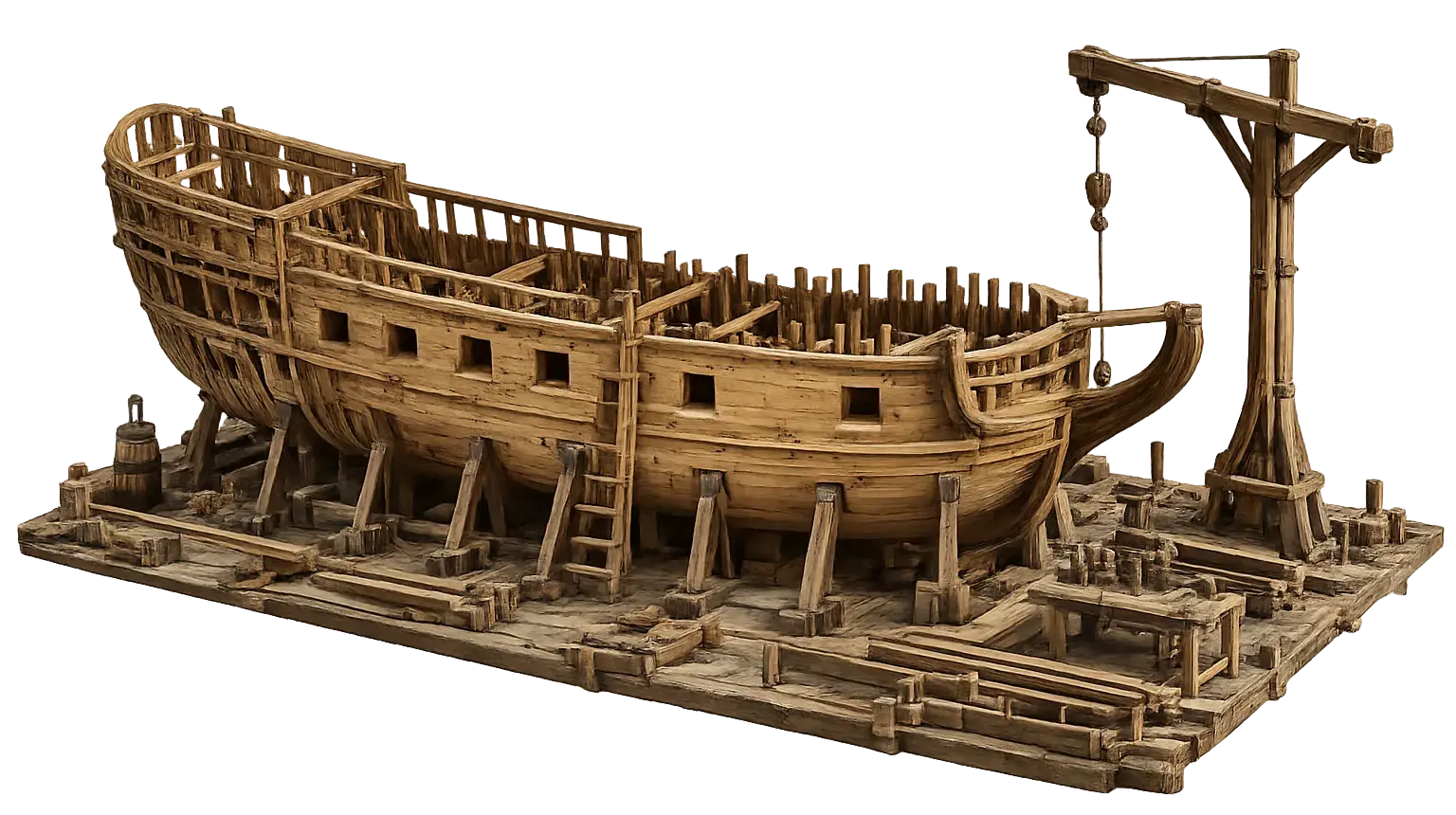
HMS Victory Technical Data
| Merkmal | Metrische Einheit | Englische Einheit |
|---|---|---|
| Länge über alles | 69,34 m | 227 ft 6 in |
| Länge des Geschützdecks | 56,69 m | 186 ft |
| Kiel-Länge | 46,10 m | 151 ft 3 in |
| Breite (Beam) | 15,80 m | 51 ft 10 in |
| Tiefgang | 8,76 m | 28 ft 9 in |
| Tiefe des Laderaums | 6,55 m | 21 ft 6 in |
| Höhe (Wasserlinie bis Mastspitze) | 62,50 m | 205 ft |
| Segelfläche | 5.440 m² | 6.510 sq yd |
| Verdrängung | 3.556 t | 3.500 long tons |
| Vermessung (Burthen) | ca. 2.177 t | 2.142 tons bm |
| Besatzung | ca. 850 Mann | ca. 850 men |
| Bewaffnung (1805) | 104 Kanonen | 104 Kanonen |
Refit and First Copper Sheathing Portsmouth, March 1780
The introduction of copper sheathing was one of the most significant technical innovations of the British Navy in the late 18th century. HMS Victory was fitted with copper sheathing during a major refit in Portsmouth between 1778 and 1780 as part of the Royal Navy’s preparations for the American War of Independence.[2]
Background: Why copper?
In the 18th century, wooden ships suffered from two serious problems: fouling of the hull by marine organisms and infestation by shipworm (Teredo navalis). Trials conducted by the Royal Navy showed that copper plating significantly reduced both problems. The frigate HMS Alarm was copper-plated in 1761, and by 1783, copper plating had become standard on important Royal Navy warships.[2]
The copper plating of HMS Victory, 1778-1780
After years in reserve, HMS Victory was in poor condition. During an extensive refit at Portsmouth (1778-1780), the ship was almost completely refurbished, including new copper plating below the waterline.[3] The plating consisted of approximately 3923 copper plates (4 feet long × 14 inches wide), fastened with copper nails to prevent galvanic corrosion.
Technical problems and solutions:
Initial copper plating attempts caused electrochemical reactions with iron bolts, accelerating corrosion. The solution was using copper bolts and corrosion-resistant fastenings.[4] The current conservation project has documented numerous original copper bolts below the waterline, some up to three meters long.[4]
Armament at Trafalgar 1805
The armament of HMS Victory according to the Royal Navy and the current HMS Victory Project in Portsmouth. According to these sources, her armament at the Battle of Trafalgar on 21 October 1805 consisted of exactly 104 guns:
| Deck | Geschütztyp | Anzahl |
|---|---|---|
| Lower Gun Deck | 32-pounder Long Gun (Blomefield) | 30 |
| Middle Gun Deck | 24-pounder Long Gun | 28 |
| Upper Gun Deck | 12-pounder Short Gun | 30 |
| Quarterdeck | 12-pounder Short Gun | 12 |
| Forecastle | 12-pounder Medium Gun | 2 |
| Forecastle | 68-pounder Carronade | 2 |
| Total | 104 |
A broadside fired approximately 540 kg of iron shot. The 68-pounder carronades were particularly feared for their devastating effect at close range.
The Carronades – The „Secret Weapon“ at Close Range
The 2 × 68-pounder carronades were the special feature of Victory’s armament:
- Short, thick barrel:
- Length: ~1.5-2 meters (vs. 3-4m for long guns)
- Caliber: 68 pounds (~31 kg shells) – nearly twice as heavy as 32-pounders
- Gun weight: ~1,000-1,200 kg (vs. 2,000-3,000 kg for long guns)
- Advantages:
- Extremely destructive at close range (<500 yards): could penetrate entire decks or tear open ship sides
- Effective against crews (grapeshot) or masts/rigging (chain shot)
- Faster reloading: smaller crew (4-5 men) and higher rate of fire (shot every 2-3 minutes)
- More stable at sea: shorter barrel meant less recoil and sway
- Disadvantages:
- Short range (effective only up to ~400-500 yards)
- Inaccurate at long range – suitable only for close combat
- Use at Trafalgar:
- Nelson used carronades deliberately in close combat when Victory came alongside enemy ships
- Their devastating effect contributed significantly to the victory
Long Guns – Precision at a Distance
| Typ | Geschossgewicht | Reichweite | Zweck |
|---|---|---|---|
| 32-Pfünder | 31 kg | ~2.000 yards (~1.800 m) | Durchschlagen von Schiffswänden |
| 24-Pfünder | 24 kg | ~1.800 yards (~1.600 m) | Mittlere Reichweite |
| 12-Pfünder | 12 kg | ~1.500 yards (~1.350 m) | Oberes Deck (gegen Masten/Takelage) |
This combination gave Victory a formidable fighting capability
| Faktor | Langrohrkanonen | Karronaden | Gesamteffekt |
|---|---|---|---|
| Reichweite | long range (lang) | short range (kurz) | Flexibilität - wirksam auf allen Distanzen |
| Zerstörungskraft | high | very high | Maximale Wirkung im Nahkampf |
| Feuerrate | moderate | very fast | Schnelles, konzentriertes Feuer |
| Verwendung | Fernkampf | Nahkampf | Taktischer Vorteil |
Historical Sources
Color Scheme 1765
- Hull: warm wood brown to honey-colored (oiled or varnished oak) Admiralty Office, 15 June 1759[1]
- Gun ports: interior sides painted red
- Ornamental moldings and galleries: deep blue
- Carvings: gilded or outlined in ochre yellow
- Transom: Blue with gold trim
- Decks: Light, weathered wood
- Masts: Natural to slightly yellowish-brown
Color Scheme 1805
Anchors
Purpose of the various anchors:
The bower anchors (port and starboard) served as main anchors for secure mooring in deep water or strong winds.
The sheet anchor was a reserve for emergencies.
The Kedge Anchor was used for precise maneuvers, while the Stream Anchor was for temporary mooring in shallow waters.
| Name des Ankers | Verwendungszweck | Gewicht | Abmessungen |
|---|---|---|---|
| Buganker (Backbord) | Hauptanker | ~55.115,57 lbs (~25.000 kg) | Länge: ~177,165 in (~4,5 m) Breite: ~165,354 in (~4,2 m) |
| Buganker (Steuerbord) | Hauptanker | ~55.115,57 lbs (~25.000 kg) | Länge: ~177,165 in (~4,5 m) Breite: ~165,354 in (~4,2 m) |
| Reserveanker | Notanker | ~4.409,25 lbs (~2.000 kg) | Länge: ~165,354 in (~4,2 m) Breite: ~74,8031 in (~1,9 m) |
| Kedge-Anker | Manöveranker | ~1.102,31 lbs (~500 kg) | Länge: ~98,4252 in (~2,5 m) Breite: ~47,2441 in (~1,2 m) |
| Stromanker | Temporäres Festmachen | ~661,38 lbs (~300 kg) | Länge: ~78,7402 in (~2,0 m) Breite: ~39,3701 in (~1,0 m) |
The Anchor Cables of HMS Victory (1805)
Dimensions, Manufacture and Places of Production
Introduction
As a First Rate ship carrying 100 guns, HMS Victory was equipped with principal anchors and their associated anchor cables according to Admiralty Establishments. These were among the largest and most technically demanding ropeworks for the Royal Navy.[12]Construction of Anchor Cables
The anchor cables were manufactured from high-quality hemp as heavy cable-laid ropes, consisting of three substantial strands laid in the opposite direction to the yarns. This construction provided strength, elasticity, and resistance to shock loading. After manufacture, cables were treated with Stockholm tar to prevent moisture damage.Dimensions of the Principal Anchor Cables
Admiralty Establishments for First Rate ships specified:| Posten | Messung |
|---|---|
| Umfang | 24 Zoll |
| Durchmesser | ~7,64 Zoll (19,4 cm) |
| Länge | 100 Faden (~183 Meter/600 Fuß) |
| Material | Hanf |
| Konstruktion | Drei-Strang-Kabelstrang |
A cable of this size weighed several tons and required specialized equipment and considerable manpower for handling.
Manufacture
Anchor cable manufacture was carried out in Royal Dockyard ropehouses, among Britain’s largest industrial establishments during the Georgian period. The process involved:[13]
- Preparation and combing of imported hemp fibres
- Spinning of yarns
- Formation of strands
- Laying-up of the completed cable
- Tarring and finishing
- Inspection by Navy Board officials
Principal Places of Production
Portsmouth Rope House
The principal source for many ships at Portsmouth was the Royal Dockyard Rope House, a structure over 1,000 feet long enabling manufacture of exceptionally long cables in a single operation. Given Victory’s long association with Portsmouth, many replacement cables were likely manufactured there.
Chatham Ropeyard
The Royal Dockyard at Chatham had a similarly important ropewalk and supplied large quantities of cordage and anchor cables. Production methods were governed by the same Admiralty regulations as at Portsmouth.
Use on Board HMS Victory
HMS Victory carried several classes of anchors: Best Bower, Small Bower, Sheet, and Stream Anchors. The heaviest cables were assigned to the principal bower anchors. When weighing anchor, a continuous messenger cable was used with nippers to attach the anchor cable, allowing it to be drawn aboard progressively as the capstan revolved. The operation required large working parties – over 100 men might be employed at the capstan bars in difficult conditions.
Rigging
The most important dimensions are known from contemporary British Admiralty regulations and reconstructions.[14]
Anchor Cables:
The largest ropes on board were the hemp anchor cables.
| Merkmal | Wert |
|---|---|
| Anzahl der Hauptkabel | 6 |
| Länge pro Kabel | ~600 Fuß = 183 m |
| Umfang | 24 Zoll = 61 cm |
| Durchmesser | ~7,6-8 Zoll = 19-20 cm |
| Gewicht pro Kabel | ~4,5 Tonnen |
| Material | Geteerter Hanf |
The two main anchors weighed 2-4.5 tons each. Hauling in required up to 144 men at the capstans.
Standing Rigging (Fixed Rigging)
The standing rigging held the masts firmly and consisted of tarred black hemp.
Main Rigging Dimensions:
| Tau | Umfang | Durchmesser |
|---|---|---|
| Großstag | 27-30 Zoll | 22-24 cm |
| Vorstag | 24-26 Zoll | 19-21 cm |
| Große Want | 21-24 Zoll | 17-19 cm |
| Toppmast-Wanten | 15-18 Zoll | 12-14 cm |
| Bramsegel-Wanten | 10-12 Zoll | 8-10 cm |
The Ropery at the former Royal Dockyard in Chatham
The Ropery at the former Royal Dockyard in Chatham was one of the most important sites for the British Navy. Built between 1786 and 1791[15], the building is approximately 346 meters (over 1,100 feet) long – necessary to produce long ship’s ropes in a single piece.
A ship of Victory’s size required about 31 miles (~50 km) of rope for rigging, anchors, and running gear. The ropes for Victory were made in Chatham, and the rope-making workshop still supplies rope for restoration work today. The Ropery is still in operation, considered the last originally preserved naval rope-making workshop in Great Britain.
The company Master Ropemakers continues to produce ropes using traditional methods for historic ships, theatres, film productions, and other specialist applications. Some production still uses Victorian-era machinery. Visitors can tour the Rope Walk and watch the rope makers at work.
The Masts
The Bow Sprit
Coming soon…
The Fore Mast
Main Spars and Parts of the Fore Mast
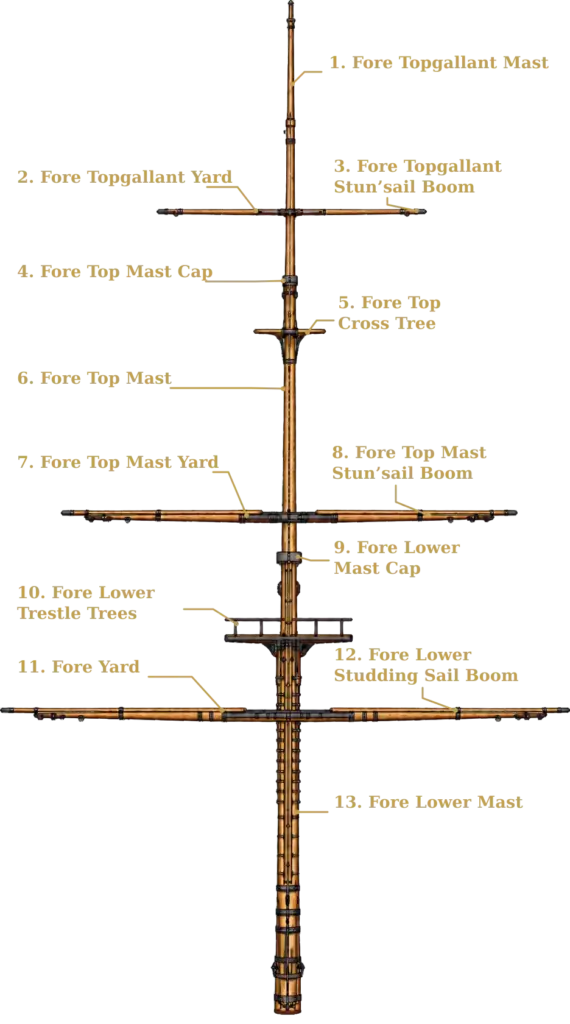
1. Fore Topgallant Mast
The Fore Topgallant Mast segment is the outermost, thinner extension furthest upward.
2. Fore Topgallant Yard
It is a horizontal wooden spar mounted on the third tier of the forward mast (the fore topgallant mast). Its primary purpose is to hold up and spread the top edge (head) of the Fore Topgallant Sail.
3. Fore Topgallant Stun’sail Boom
It is a specialized, temporary wooden spar used to physically extend the width of the ship’s lowest forward sail plan.
4. Fore Top Mast Cap
Serves the exact same mechanical purpose as the lower mast cap, just one tier higher up the rigging assembly.
It is a heavy, iron-reinforced wooden block fitted to the very top of the Fore Topmast. Its primary purpose is to act as a structural collar that links the topmast to the Fore Topgallant Mast above it.
5. Fore Top Cross Tree
Are horizontal timber beams mounted on the second tier of the forward mast (at the head of the Fore Topmast). They run athwartships from larboard to starboard.
6. Fore Top Mast
The Fore Top Mast segment is the first extension of the Fore Mast pointing upward.
7. Fore Top Mast Yard
It is a horizontal wooden spar mounted directly above the Fore Yard. Its primary purpose is to hold up and spread the top edge of the Fore Topsail, which is the second square sail up from the deck on the Fore Mast.
8. Fore Top Mast Stun’sail Boom
It is a specialized, temporary wooden spar used to physically extend the width of the ship’s lowest forward sail plan.
9. Fore Lower Mast Cap
It is a heavy, iron-reinforced wooden block fitted directly onto the very top of the lowest Fore Mast.
Its primary purpose is to act as a structural collar that links the lower mast to the upper mast – the Fore Topmast, holding them rigidly parallel to one another.
10. Fore Lower Trestle Trees
Are two heavy, parallel timber beams running fore-and-aft on either side of the lowest section of the Fore Mast head.
Their primary purpose is to act as the primary load-bearing foundation for the entire upper mast structure and rigging on the Fore Mast. They bear immense downward and lateral forces, transferring all that weight directly into the solid lower mast.
11. Fore Yard
It is a massive, horizontal wooden spar mounted to the Fore Mast that acts as the primary support structure for the ship’s largest forward sails.
12. Fore Lower Studding Sail Boom
It is a specialized, temporary wooden spar used to physically extend the width of the ship’s lowest forward sail plan.
13. Fore Lower Mast
The Fore Lower Mast is the massive primary section of the mast, firmly stepped into the keel structure and extending upward through the decks.
| Component | Length: Imperial Unit | Length: Metric Unit |
|---|---|---|
| Fore Lower Mast above Forecastle Deck | 151' - 10'' | 46.28 m |
| Fore Lower Mast below Forecastle Deck | 38' - 6'' | 11.73 m |
| Fore Lower Mast Total length | 190' - 4'' | 58.0 m |
| Fore Top Mast | 63' - 0'' | 19.20 m |
| Fore Topgallant Mast | 57' - 7'' | 17.55 m |
| Fore Lower Studding Sail Boom | 54' - 0'' | 16.45 m |
| Fore Yard | 89' - 0'' | 27.12m |
| Fore Top Mast Stun'sail Boom | 44' - 6'' | 13.56 m |
| Fore Top Mast Yard | 64'- 6'' | 19.66 m |
| Fore Topgallant Stun'sail Boom | 62' - 3'' | 18.97 m |
| Fore Topgallant Yard | 43' - 0'' | 13.10 m |
| Fore Lower Trestle Trees | 21' - 10'' × 16' - 8'' Dimensions refer to plank sizes before framing. | 6.655 × 5.080 m |
| Fore Top Cross Tree | 6' – 1.5'' × 10 ' - 2.5 '' | 1.86 × 3.11 m |
| Fore Lower Mast Cap | 7' - 1'' × 8'-6.5'' × 1' - 7'' | 2.15 × 2.60 × 0.48 m |
| Fore Top Mast Cap | 3' - 9'' × 1' – 9.5'' × 9.375'' | 1.14 × 0.54 × 0.23 m |
The Main Mast
Coming soon…
The Mizzen Mast
Coming soon…
Historical References
- Original ship plans, Chatham Dockyard, 1759-1765: Technical drawings and specifications for HMS Victory. [1]
- Royal Navy trials and records: Copper sheathing experiments (1761-1783) and adoption across the fleet. Includes HMS Alarm trial (1761) and standardisation by 1783. [2]
- Portsmouth Dockyard refit records: HMS Victory copper sheathing installation, 1778-1780. Details include ~3,500 copper plates (4ft × 14in) fastened with copper nails. [3]
- Admiralty technical reports: Electrochemical corrosion issues between copper plates and iron bolts, and the solution using copper fastenings. Documents original copper bolts up to 3m long found during conservation. [4]
- Admiralty records: Armament configuration of HMS Victory at the Battle of Trafalgar, 21 October 1805. [5]
- Royal Gun Foundry Woolwich Arsenal records: Manufacturing details of 32-pounders, 24-pounders, and 12-pounders for HMS Victory. [6]
- Carron Company, Falkirk, Scotland: Production records of 68-pounder carronades supplied to the Royal Navy. [7]
- Naval warfare records: Documented effectiveness of carronades at close range (under 500 yards) during late 18th century engagements. [8]
- Technical specifications: Design advantages of carronades including faster reloading, stability at sea, and reduced crew requirements. [9]
- National Museum of the Royal Navy restoration records, 1800-1803: Documentation of repainting during the Great Repair, including adoption of the Nelson Chequer pattern. [10]
- Admiralty anchor specifications, late 18th century: Technical details of anchors aboard HMS Victory, including dimensions and weights. [11]
- Admiralty Establishments for First Rate Ships: Anchor cable specifications (24-inch circumference, ~183m length) and standardization requirements. [12]
- Royal Dockyard records: Rope manufacturing processes at Portsmouth and Chatham dockyards, including quality control and inspection procedures. [13]
- British Admiralty regulations, late 18th century: Contemporary specifications for rigging dimensions and materials aboard ships of the line. [14]
- Historic Dockyard Chatham records: Construction (1786-1791) and continuous operation of the Ropery, including its role in supplying rope for HMS Victory. [15]