

About This Website
This website is the result of many years of study devoted to HMS Victory and reflects my continuing interest in her history, construction and remarkable craftsmanship. Its purpose is to present these subjects as faithfully as possible on the basis of historical sources and established research.
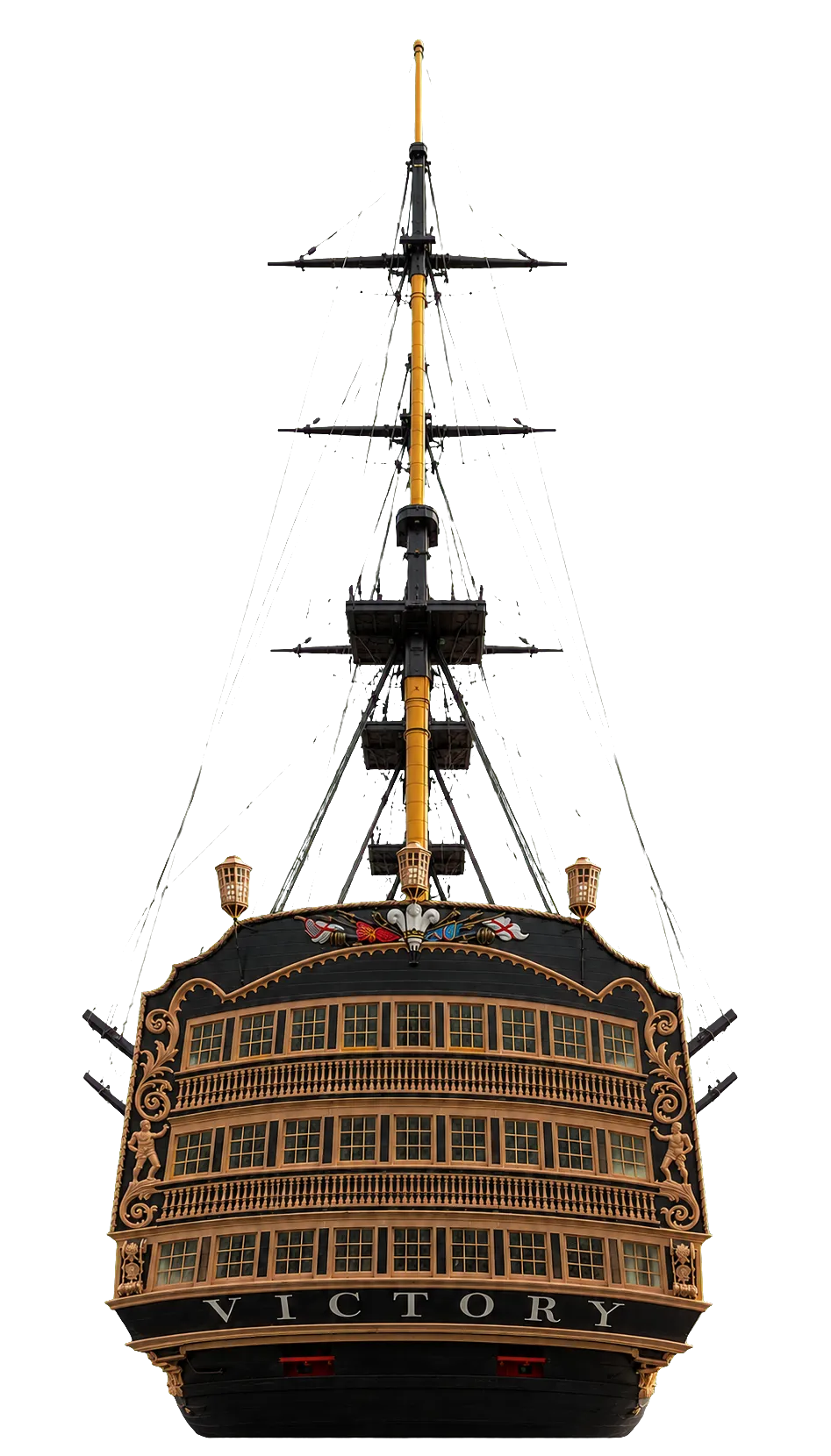
The principal focus of this website is HMS Victory herself as one of the finest achievements of eighteenth-century naval architecture. The historical events with which she is associated provide the background; the ship herself remains the central subject throughout.
Mission
Purpose
The purpose of this website is to bring together historically documented information, technical understanding and the experience gained from the reconstruction of a 1:48 scale model of HMS Victory.
The articles are based upon contemporary documents, surviving Royal Navy records, historic plans and recognised reference works. Wherever possible, information from different sources has been carefully compared and evaluated in order to present the most reliable interpretation currently available.
Contents
Among the subjects covered are:
- The history of HMS Victory from her construction to the present day.
- Her design, construction and structural development.
- Masts, rigging, sails and fittings.
- Armament, colour schemes and numerous constructional details.
- The various restoration programmes, including the present Big Repair.
- The reconstruction of a 1:48 scale model based upon historical evidence.
- Sources, references and supporting documentation.
The website continues to develop alongside the project itself and is revised and expanded whenever new information becomes available.
For Whom This Website Is Intended
This website is intended for everyone with an interest in HMS Victory and the shipbuilding traditions of the Age of Sail.
Whether historian, modeller, museum visitor, student or simply someone with an appreciation of traditional craftsmanship, maritime history and historic ships, all are most welcome.
A Final Word
This website is not intended to be a definitive work on HMS Victory. Rather, it reflects an ongoing process of research and reconstruction. New findings from historical sources, together with practical experience gained during the reconstruction of the model, will continue to shape its development.
It is my hope that this website will contribute, in some small measure, to a better understanding of HMS Victory as one of the most remarkable historic ships of her time, and perhaps convey something of the fascination that she has held for me over so many years.
Introduction
My first encounter with HMS Victory dates back many decades.
I was six years old when I first came across her—not in a museum, nor in a history book, but as the highest-ranking card in a naval quartet game that we played enthusiastically during our school breaks. To me she was simply the strongest ship in the pack. Naturally, I could never have imagined that this particular vessel would one day become the subject of such enduring interest.
The great wooden warships of the Age of Sail have always held a particular fascination for me. To my mind, HMS Victory represents the culmination of their development. As one of the most distinguished First Rates of the Royal Navy, she combines elegant lines, well-balanced proportions and the very highest standards of eighteenth-century naval architecture. She may justly be regarded as the masterpiece of her designer, Sir Thomas Slade.
Many years later, when I decided to build a historical ship model, there was never any doubt which vessel I would choose. It could only be HMS Victory. After completing two plastic kits from different manufacturers, I eventually turned to a wooden kit. Once the hull had been completed, however, it became clear that the result fell short of my own expectations of historical accuracy.
It would undoubtedly have made an attractive model. But that was never my objective. I did not simply wish to reproduce HMS Victory; I wanted to understand the original ship.
My aim was therefore to reconstruct HMS Victory as faithfully as possible on the basis of the surviving contemporary sources of the Royal Navy. This required the study of historical documents, numerous calculations, the preparation of working drawings at the drawing board, the design of specialised jigs and construction aids, and only then the commencement of the actual build.
The reconstruction presented here is based upon surviving Royal Navy specifications, publications issued by HMSO, together with the principal plans and standard reference works. Among the most important are:
- John McKay – The 100-Gun Ship Victory
- James Lees – The Masting and Rigging of English Ships of War, 1625–1860
- Brian Lavery – The Arming and Fitting of English Ships of War, 1600–1815
- Peter Goodwin – The Construction and Fitting of the English Man of War, 1650–1850
- Arthur Bugler – H.M.S. Victory: Building, Restoration and Repair (HMSO, 1966)
As so often happens, the project gradually developed far beyond its original scope. The more deeply I immersed myself in the study of HMS Victory, the more questions arose. Every answer led to new discoveries and opened further insights into the shipbuilding practice and craftsmanship of the eighteenth century. What began as a model-building project gradually evolved into an extensive study of naval history, construction and traditional craftsmanship.
The research, observations and selected results of this work are presented on this website. It offers an insight into the project itself, while also exploring the historical background, individual stages of construction and a number of the technical solutions that emerged during the course of the reconstruction.
Like the project itself, this website continues to grow. With each new discovery and every further stage of construction, it is revised and expanded.
It is my hope that it may also convey something of the fascination that HMS Victory has held for me for so many years.
In My Own Words
Every modeller approaches HMS Victory from a different perspective. Some choose to represent her as launched in 1765, others after the Great Repair of 1800–1803, at Trafalgar in 1805, or as she survives today. Each interpretation reflects a particular moment in the ship’s long history, and each deserves equal respect when based upon careful study.
I make no claim that my reconstruction is the definitive HMS Victory. It is simply my own reconstruction, based upon the evidence available to me at the time of writing.
My intention is neither to establish historical authority nor to suggest that my interpretation is superior to that of others. Rather, I have chosen to reconstruct HMS Victory in her 1805 “Cleared for Action” configuration, drawing upon original documents, contemporary records, surviving evidence, and the work of historians, curators, researchers, and fellow enthusiasts whose dedication to this remarkable ship I greatly respect.
Historical research is never static. New discoveries continue to expand our knowledge, and future evidence may refine or even alter what is currently understood. Should that happen, I shall gladly continue learning and adapt my own reconstruction accordingly.
This project reflects my own journey of discovery. I hope that visitors may find something of interest here, whether they share my conclusions or simply enjoy exploring the history of one of the Royal Navy’s most remarkable ships.
My Recommendation
If you would like to explore the remarkable history of HMS Victory in greater depth, I highly recommend the following museums and institutions.
Whether you are planning a visit, seeking further information, conducting research, or simply wishing to learn more, these organisations offer expert guidance and fascinating exhibitions dedicated to HMS Victory – one of the most remarkable ships among the legendary “Wooden Walls” of the Royal Navy.
National Museum of the Royal Navy, Portsmouth (HMS Victory)
Address: HM Naval Base, Portsmouth PO1 3LJ, United Kingdom
Website: www.nmrn.org.uk
Email: info@nmrn.org.uk
Portsmouth Historic Dockyard
Address: Victory Gate, HM Naval Base, Portsmouth PO1 3LQ, United Kingdom
Website: www.historicdockyard.co.uk
Email: info@historicdockyard.co.uk
The Historic Dockyard Chatham
Address: Chatham, Kent ME4 4TE, United Kingdom
Website: thedockyard.co.uk
Email: info@chathamdockyard.co.uk
Royal Museums Greenwich (National Maritime Museum)
Address: Romney Road, Greenwich, London SE10 9NF, United Kingdom
Website: www.rmg.co.uk
Email: info@rmg.co.uk
Sources & References
The information presented throughout this website is based upon historical sources, contemporary documents, Royal Navy publications, archival material and recognised reference works relating to HMS Victory and the shipbuilding traditions of the Age of Sail.
Every effort has been made to ensure the accuracy of the information presented. Nevertheless, the contents are not intended to be exhaustive, and new research or additional evidence may from time to time lead to the revision or expansion of individual sections.
This website is a private and independent research and reconstruction project. It has no affiliation with the National Museum of the Royal Navy, the Royal Navy, HMSO, or any other institutions or organisations referred to within these pages.